
Energy can be complicated. Let’s walk through your energy bill.
San Diego Community Power customers receive one bill from SDG&E. Community Power appears as a line item on your SDG&E bill, but this is not an extra charge. We are simply replacing the electricity generation charge that you would otherwise pay to SDG&E.
Community Power purchases electricity generated from more renewable sources on behalf of our customers. SDG&E delivers this electricity to you and maintains the power lines. Customers receive one bill, which includes charges for electricity generation and electricity delivery.
This refers to the energy that you are using. Rates vary depending on which Community Power service plan you choose or if you choose to return to SDG&E’s electricity generation service. You can view our service plans here.


This is a sample bill. Your charges will vary depending on your service plan and energy usage.
If you have rooftop solar, view our Net Energy Metering (NEM) page or Solar Billing Plan (SBP) page for more applicable information.
If you are a medium or large commercial customer, please note that your bill may include an additional “Demand On-Peak Summer” line item under your CCA Electricity Generation Charges between June 1 and October 31. This charge is applied to the highest kilowatt demand (kW) that occurs during peak demand periods and recovers the generation costs of meeting peak energy demands. The Summer On-Peak Demand charge is assessed for some medium and large commercial rates, whether you are enrolled in Community Power or SDG&E electricity generation services. If you’d like more information on how this may impact your bill, please call our Contact Center at 888-382-0169.
Click on the numbers below for descriptions of each line item on the bill sample.
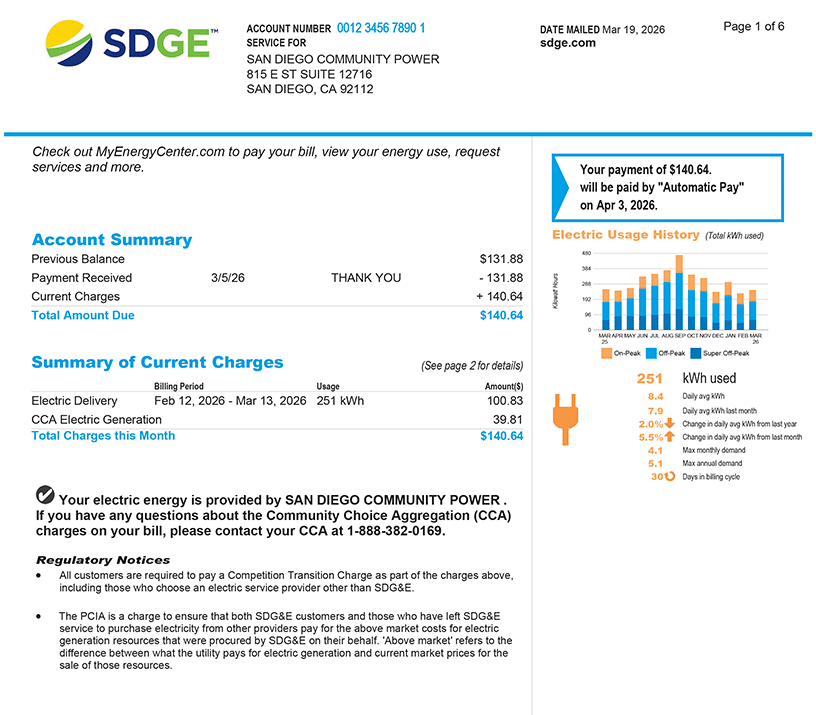
Please have this number on hand to make changes to your service.
This section provides an overview of your total electricity delivery charges from SDG&E and total electricity generation charges from Community Power. These charges are explained in more detail below.
This chart shows your electricity usage month over month for the past year.

This chart shows the total bill costs associated with each service provided, including electricity generation (Community Power), electricity transmission and delivery (SDG&E) and gas (SDG&E).
This SDG&E charge for residential customers reflects certain fixed costs related to the energy grid (including transformers, meters and customer services) that, prior to October 2025, were included in SDG&E's electricity delivery charges.
These SDG&E charges cover the cost of delivering electricity through SDG&E's power lines to your home.
This credit shows what SDG&E would have charged you if it provided your electricity generation service. SDG&E issues this charge back to Community Power customers as a credit so you do not pay double for generation charges.
SDG&E collects this fee to cover the cost of energy that it contracted for its customers. The PCIA is paid by all customers, whether you are enrolled in Community Power electricity generation services or not. The PCIA is not a new charge — it was previously included in SDG&E’s electricity generation charges but is now broken out as a separate line item.
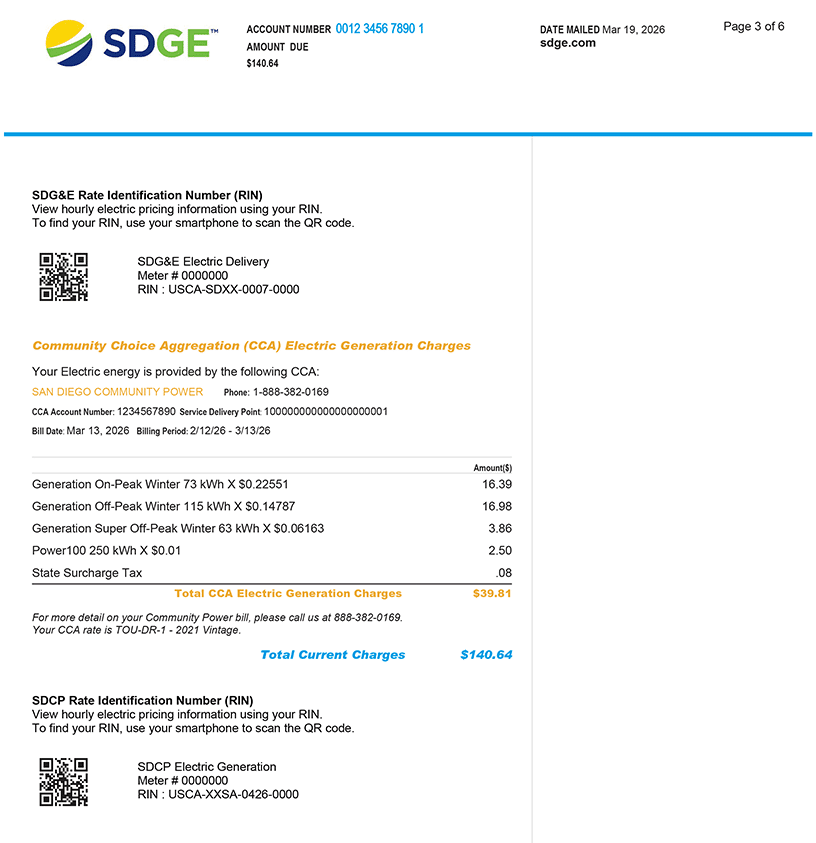
These Community Power charges cover the cost of the actual electricity that you used during the billing period. This is not an additional charge. It simply replaces the electricity generation charge that you would otherwise pay to SDG&E.
If you are enrolled in Community Power’s 100% renewable Power100 service, your bill will include an additional line item showing the premium for this service. You can view our service plans here.
If you are enrolled in Community Power’s PowerBase service plan, your bill will show "PowerBase" directly after your CCA rate and vintage year under Community Power charges. For example, this bill would read “Your CCA rate is TOU-DR-1 - 2021 Vintage - PowerBase.”
If you do not see “PowerBase” after your vintage year or a Power100 line item on your bill, then you are likely enrolled in our standard PowerOn service plan. You can view our service options here.
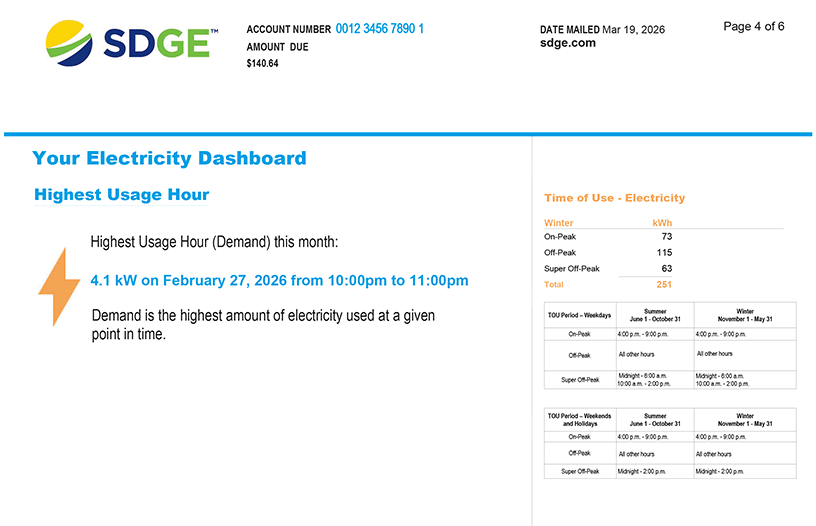
When you use energy matters just as much as how much energy you use. For customers on Time-of-Use (TOU) rate schedules, this page identifies your highest usage hour over the billing period and outlines the pricing windows for electricity.
Electricity is most expensive during “on-peak” hours, when demand is highest. It is least expensive during “super off-peak” hours. Learn more on our Time-of-Use page.
You have the power to choose the service plan that works best for you.
Saving electricity can be easy — and can help you save on your energy bill.
Local, state and/or federal payment assistance could help you save on your energy bill.